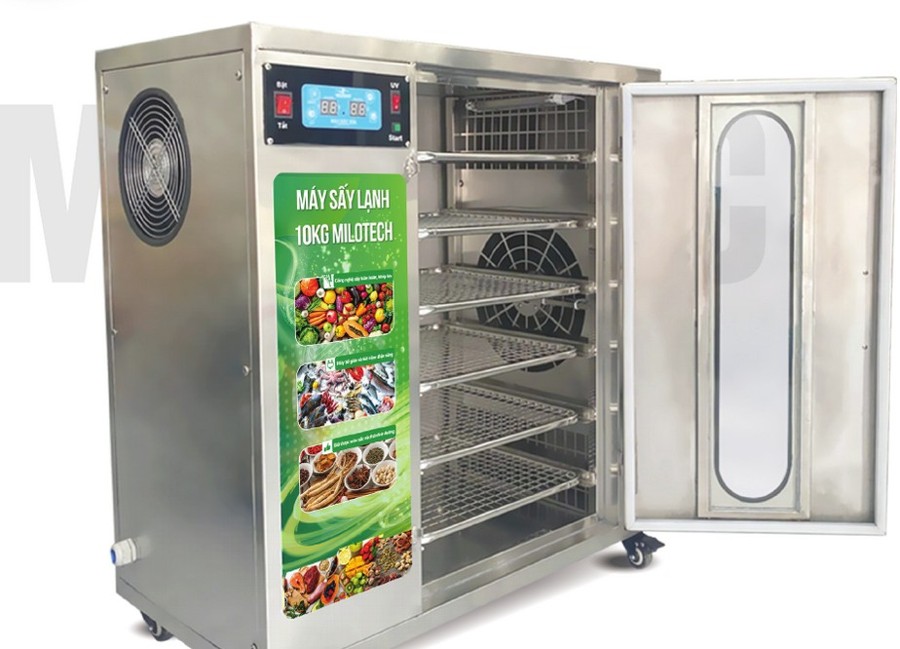
How low-temperature air drying works
In a low-temperature air dryer, air is circulated through the product while moisture is removed from the drying air. As the air passes across the food, water moves from the material into the air stream, and the drying system manages that moisture-laden air for continued drying. Compared with higher-temperature processing, this approach is considered when the product or ingredient requires a gentler thermal environment. Actual drying time and loading suitability vary with factors such as raw material composition, piece size, surface area, initial moisture and the desired endpoint.
Low-temperature drying is not vacuum freeze drying
Low-temperature air drying and vacuum freeze drying use different technical principles. Air drying removes moisture while the product is exposed to circulating air at a controlled temperature. Vacuum freeze drying first freezes the product and then removes ice under vacuum through sublimation. Freeze drying can therefore require a different equipment configuration, process sequence and investment assessment. Buyers should identify the product objective before comparing equipment: a low-temperature air dryer may be the relevant route for a controlled air-drying application, while freeze drying is a separate process category.
What buyers should evaluate before selecting a dryer
A factory assessment should begin with the raw material and the intended output rather than the equipment name alone. Discuss the material form, batch weight, tray or loading method, starting moisture, desired final condition, acceptable temperature range and expected cycle repeatability. It is also important to consider preparation steps, cleaning access, operator controls, available floor space and how the dryer will fit into upstream and downstream equipment. These details help define a practical configuration and prevent a nominal batch size from being treated as a universal result for every product.
Milotech low-temperature model range
Milotech’s international catalogue lists low-temperature food drying models of 5, 10, 20, 50 and 100 kg. Suitable loading and drying cycles depend on the raw material, so the catalogue range should be treated as a starting point for application discussion. Milotech’s 20 kg low-temperature food dryer product page describes drying at 30–60°C and a seven-tray design; final model specifications should be confirmed before purchase. Buyers can use their actual product and batch requirements to narrow the appropriate model and configuration.
Factory consultation and acceptance planning
A useful equipment discussion should cover the product, package or loading format, expected output and the controls required by the factory. Milotech welcomes international customers to visit its Vietnam factory to discuss assembly, controls, demonstrations and an agreed factory acceptance test before shipment. This gives the buyer an opportunity to clarify the proposed configuration and review how the equipment will be evaluated before delivery.
Contact Milotech to discuss your food product, batch size, loading or package format, expected output and equipment configuration. Share your raw-material details so the appropriate low-temperature model and drying approach can be reviewed with the factory team.